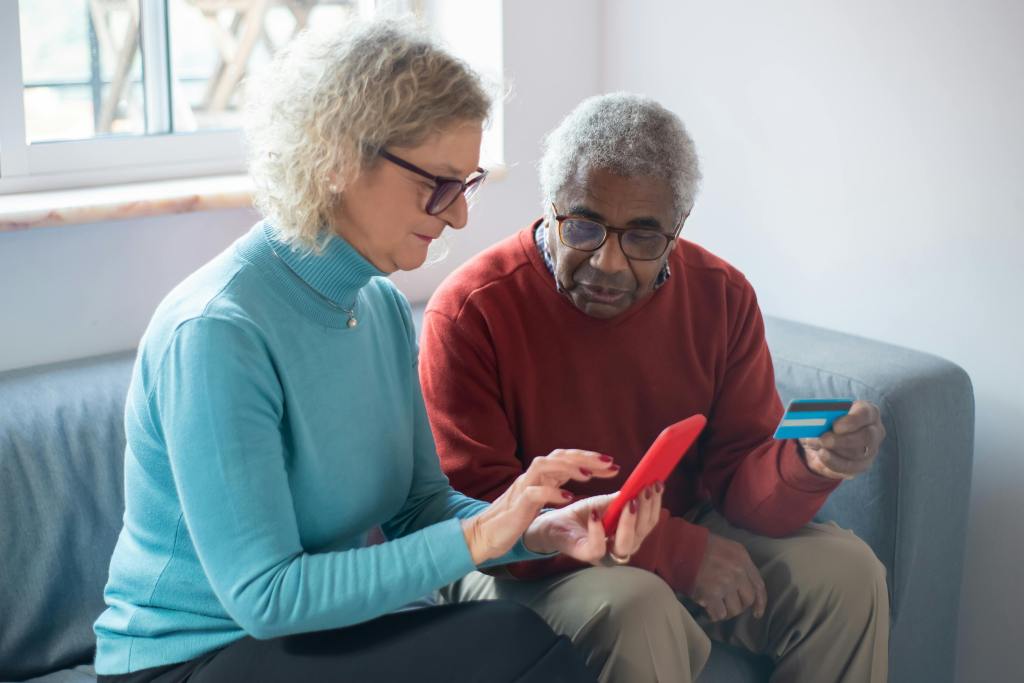
Photo Credit: Pexels – Kampus Productions
A Modern, Human-Centered Framework for Protecting Seniors, and Strengthening Our Cyber Future
Cybersecurity often moves at the speed of innovation, but the human beings who depend on it don’t. We repeat phrases like “security starts at home” and “everyone plays a role,” but we rarely ask who’s actually being equipped to do that and who’s being left behind.
Over the past two weeks alone, I’ve had more conversations about ageism, exclusion, and cybersecurity blind spots than I can count. And the striking part? These conversations came from people of all ages, backgrounds, and walks of life, all repeating the same fears, the same warnings, the same assumption that certain age groups “can’t learn this.”
And that’s when it hit me:
We are not protecting the cybersecurity pipeline if we are not protecting every generation in it.
Cybersecurity is not a young person’s game.
It is not a tech-only game.
It is a people game, and seniors are among the most targeted, most vulnerable, and most forgotten groups in our digital ecosystem.
It’s time to change that.
That’s why I built the AQ’S Corner Senior Cybersecurity Framework Model™, a A human-centered model inspired by four foundational cybersecurity standards and controls: NIST, CIS, SANS, and ISO.
Not watered down.
Not over-simplified.
Just restructured in a way that makes sense for seniors and the people who train them.
This framework was already in development, but the urgency became undeniable. After hearing story after story about digital scams, isolation, confusion with technology, and age-based gatekeeping, I realized something:
If we don’t empower seniors, we weaken the whole system.
Every family.
Every workplace.
Every community.
Every digital space.
They are grandparents, caregivers, veterans, volunteers, educators, workers, voters, neighbors, and they deserve cybersecurity that respects them, not dismisses them.
This framework is part of my bigger mission:
To teach cybersecurity in a way that lifts people up, not pushes them out.
To build confidence, not fear.
To create access, not intimidation.
To keep families safe.
To protect the pipeline.
To empower every generation.
Let’s walk through the model.
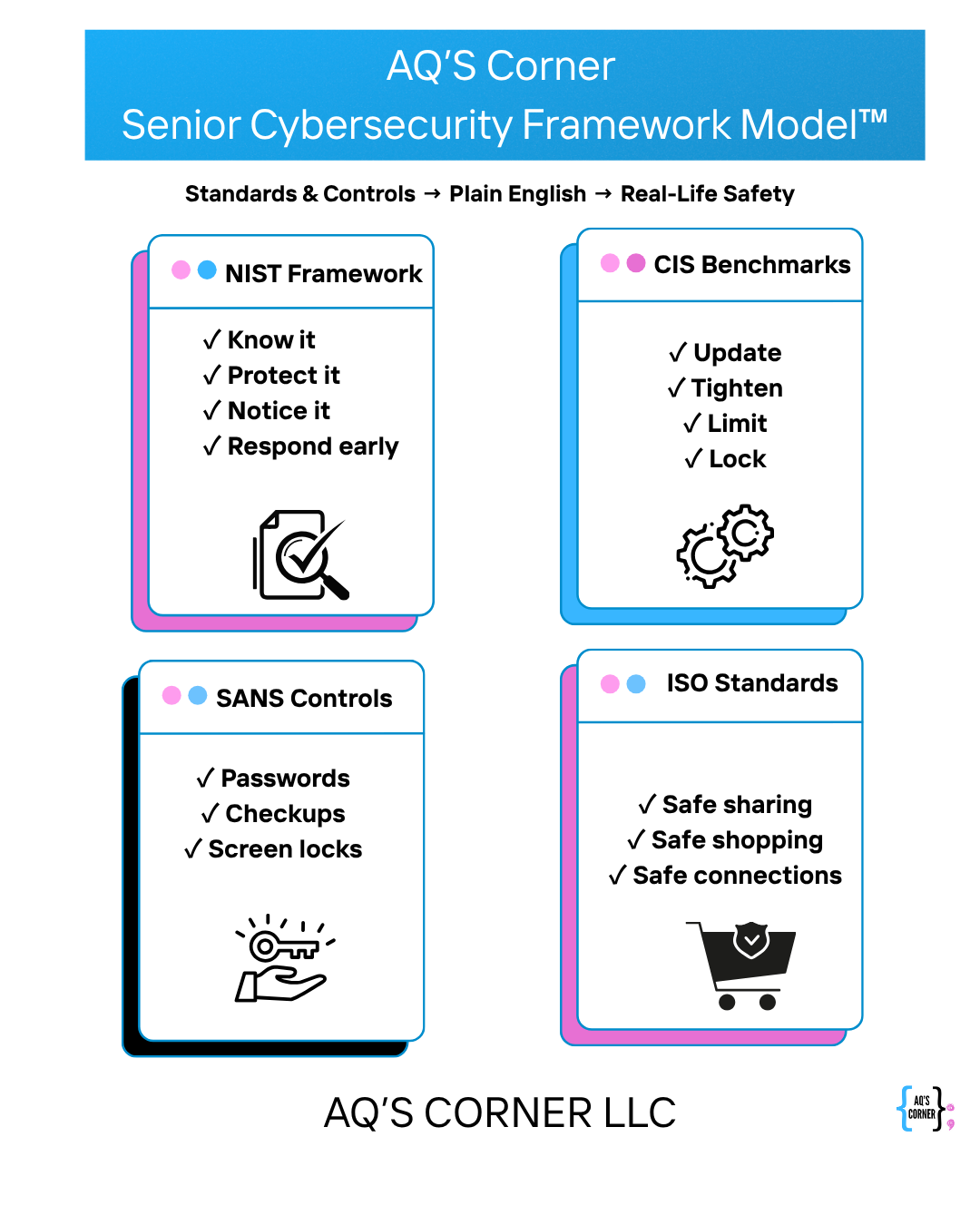
The AQ’S Corner Senior Cybersecurity Framework Model™
Designed to simplify cybersecurity without losing depth, for seniors and those who support them.
This model distills the most essential principles from four major cybersecurity standards and controls into plain-English, real-life safety skills seniors can use every day.
It is divided into four pillars:
- Awareness & Devices (Based on NIST)
- Settings & Privacy (Based on CIS Benchmarks)
- Digital Habits & Credentials (Based on SANS Controls)
- Online Safety & Behavior (Based on ISO Standards)
Each pillar honors the original security standards and controls, keeps their integrity, and translates them into clear, senior-friendly guidance.
Let’s break it down.
🔵 1. Awareness & Devices (NIST Framework)
NIST — the National Institute of Standards and Technology- is the backbone of American cybersecurity. Millions rely on it: federal agencies, hospitals, banks, and critical infrastructure.
But at its heart, NIST is built on five simple ideas:
- Identify
- Protect
- Detect
- Respond
- Recover
For seniors, we reframe that into something clear and actionable:
✓ Know it
Know your devices: phone, tablet, laptop, email, apps.
✓ Protect it
Use passwords, update apps, and enable security tools.
✓ Notice it
Recognize when something feels off, pop-ups, weird messages, and unexpected logins.
✓ Respond early
Ask for help immediately.
Trust your instincts.
Don’t wait.
This pillar strengthens awareness, intuition, and early detection, skills seniors absolutely can master when taught respectfully.
🔴 2. Settings & Privacy (CIS Benchmarks)
The Center for Internet Security (CIS) creates step-by-step instructions for hardening devices.
Translated for seniors, this becomes:
✓ Update
Updates fix vulnerabilities scammers target.
✓ Tighten
Adjust privacy and security settings.
✓ Limit
Restrict app permissions: camera, microphone, location.
✓ Lock
Use PINs, screen locks, and device safeguards.
This pillar builds control, confidence, and digital independence.
🟡 3. Digital Habits & Credentials (SANS Controls)
SANS is known for practical, everyday security behaviors. It’s one of the most useful resources for seniors because it focuses on what people do, not just what they know.
✓ Passwords
Use strong passphrases.
✓ Checkups
Review accounts. Update devices. Run security scans.
✓ Screen locks
Auto-lock your screen to prevent unauthorized access.
This pillar strengthens the daily habits that keep accounts secure.
🟢 4. Online Safety & Behavior (ISO Standards)
ISO, the International Organization for Standardization, emphasizes global safety standards, clarity, and trust.
For seniors:
✓ Safe sharing
Don’t give personal information through links or unknown messages.
✓ Safe shopping
Verify websites before entering payment details.
✓ Safe connections
Stick to trusted Wi-Fi. Verify people before responding.
Don’t click fast. Don’t click blindly.
This pillar empowers digital common sense and caution, which seniors already have; they just need guidance in the modern context.
Why This Matters, And Why I’m Doing This
Age should never be a cybersecurity risk factor. When we push older adults out of the digital conversation, we lose wisdom, insight, and generational strength, and scammers know it. They target seniors precisely because they appear isolated and unprotected. Cybersecurity, at its core, isn’t just about code, tools, and firewalls; it’s about people. And we cannot keep building programs that serve only one age group. When seniors feel confident online, families become safer, communities become safer, workplaces become safer, caregivers and children become safer.
That’s why this framework is part of a much larger movement I’m building, a mother-daughter, community-centered mission to make cybersecurity inclusive, accessible, and deeply human. It’s designed for:
- Libraries
- Senior centers
- Church groups
- Veteran communities
- AARP chapters
- Families
- Caregivers
- Educators
- Workplaces
Cybersecurity belongs to all of us. If we don’t protect every generation, we weaken the entire pipeline, from childhood to elder adulthood. My work sits at the intersection of caregiving, community, cybersecurity, and digital empowerment, and I’m committed to filling the gaps others aren’t willing to address. This is bigger than a graphic, bigger than a blog post, bigger than a workshop. It’s a national need, and a generational responsibility.
What’s Next for the Framework
This model is just the beginning. I’m already expanding this work into a series of Senior CyberHero Missions, printable resources, and hands-on digital safety activities designed specifically for older adults. I’m also developing senior-friendly challenges, simple training tools for caregivers and community leaders, and opportunities for intergenerational learning. All of it is rooted in this framework, and all of it is built on one core belief: every generation deserves digital confidence.
A New Standard
This is the beginning of a new standard. One where cybersecurity is not reserved for the tech-savvy or the young, but shared across generations with dignity, clarity, and purpose. If we want a safer digital future, it starts with frameworks like this, and with the courage to teach those who’ve been overlooked for far too long.
🔗 Explore the Full Framework
Then drop this copy:
To support seniors, caregivers, libraries, and community educators, I created the AQ’S Corner Senior Cybersecurity Framework Model™, a practical, human-centered framework built from NIST, CIS, SANS, and ISO principles.
You can explore the full model, download the graphic, and follow upcoming Senior CyberHero Missions™ here:
🔗 https://github.com/CybersecurityMom/aqs-corner-senior-cybersecurity-framework




 AQ'S Corner
Leave a reply to The Everyday Habits That Help Seniors Stay Safe: A Senior Guide to SANS Controls – AQ'S Corner Cancel reply