
Most databases are built to track assets, customers, transactions, or risk.
GratitudeOps was built to track something else entirely: people.
Specifically, the people who showed up when outcomes were uncertain. The ones who gave time, insight, introductions, money, encouragement, or credibility when there was no guarantee of return.
After a layoff, while rebuilding my business, I became acutely aware of how much invisible labor goes unrecorded. Support happens in conversations, referrals, late night reviews, quiet advocacy, and moments where someone puts their reputation on the line for you. None of that fits neatly into a CRM. But it matters deeply.
So I built a database for it.
What GratitudeOps Is
GratitudeOps is a local first, privacy aware command line tool for tracking support, gratitude, and reciprocity. It allows you to record who helped you, how they helped, and the impact of that support in a structured way.
It is intentionally simple. There is no cloud, no accounts, and no dashboards. The data lives on your own computer, in a local database file you control.
This project started as a private tool. My personal version is not uploaded anywhere. It contains real names, real notes, and real moments of support. That version stays local by design.
Why I Made a Public Version
While the data itself is private, the idea felt bigger than me.
Many people have strong support systems and no intentional way to remember or honor them in a structured way. Others want to build reciprocity into how they work but lack tools that respect privacy, nuance, and personal context.
That is why I created a public version of GratitudeOps and released it as an open source template.
The public repository is not a database of people. It is a blueprint.
Anyone can fork it, run it locally, and decide for themselves how to use it. You can keep it private. You can adapt it. You can build something new on top of it. The choice is yours.
The public repository is available here:
https://github.com/CybersecurityMom/gratitudeops
How It Is Built
From a technical standpoint, GratitudeOps is deliberately straightforward.
It is written in Python. It uses SQLite for local storage. It runs in a terminal. It has no external dependencies.
I built it using Visual Studio Code, the macOS terminal, and standard Python tooling. There is nothing exotic here, and that is intentional. This project is not about complexity. It is about clarity, auditability, and approachability, especially for people who are still learning.
The repository includes safeguards to help prevent accidental uploads of personal data. The database file is local, and users are encouraged to keep it that way.
Community as Infrastructure
We talk about infrastructure when we talk about systems, platforms, and pipelines.
But none of that works without people.
People who explain things. People who connect dots. People who take chances on you. People who say your name in rooms you are not in.
GratitudeOps exists to make that visible, at least to yourself.
It is also an invitation. My hope is that others use this tool to build their own practices of remembrance and reciprocity. Track mentorship. Track collaboration. Track advocacy. Use it as a mirror for how support actually flows through your work and your life.
Open Source With Intention
GratitudeOps is open source and licensed with attribution required. Ideas like this should travel. But the data should not.
That distinction matters.
This project is not about performance or optics. It is about stewardship. It is about acknowledging that none of us builds alone and choosing to remember that support with care and intention.
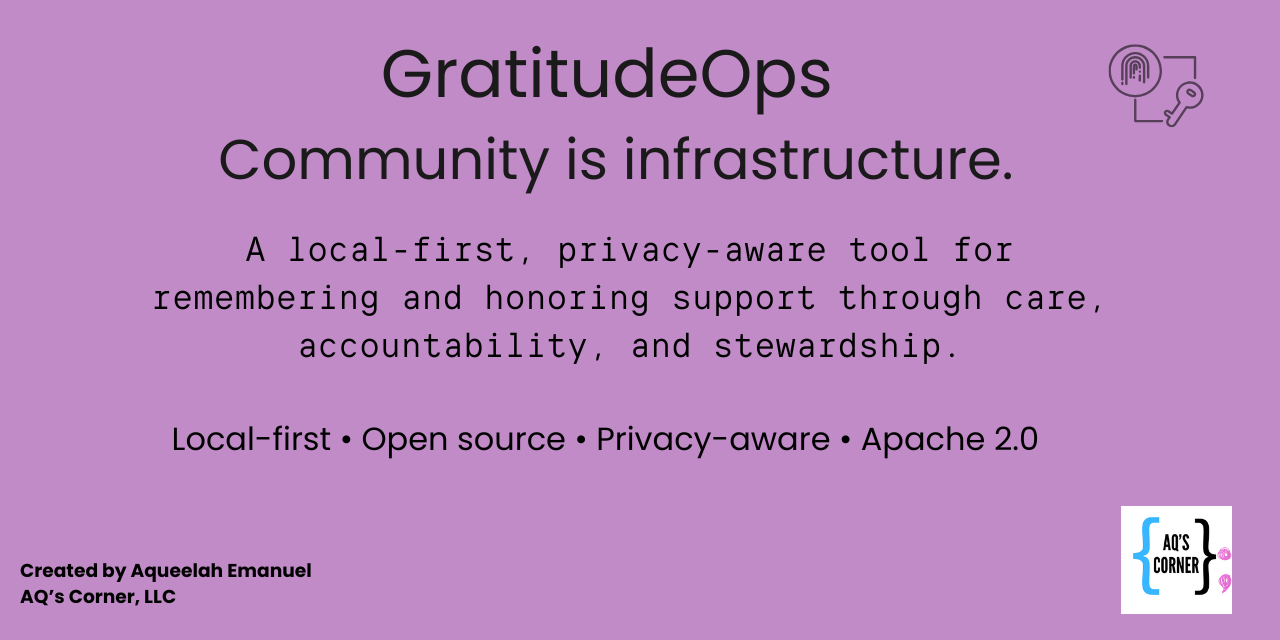
Community is infrastructure. GratitudeOps is one way to treat it that way.




 AQ'S Corner
Leave a comment